dggrid4py.DGGRIDv8
The DGGRIDv8 class has been introduced to provide custom parameters to the DGGRID version 8.x series.
For “default” or “classical” behavior of dggrid4py parameter handling, the DGGRIDv7 class should be used.
How to pass additional parameters to DGGRIDv8:
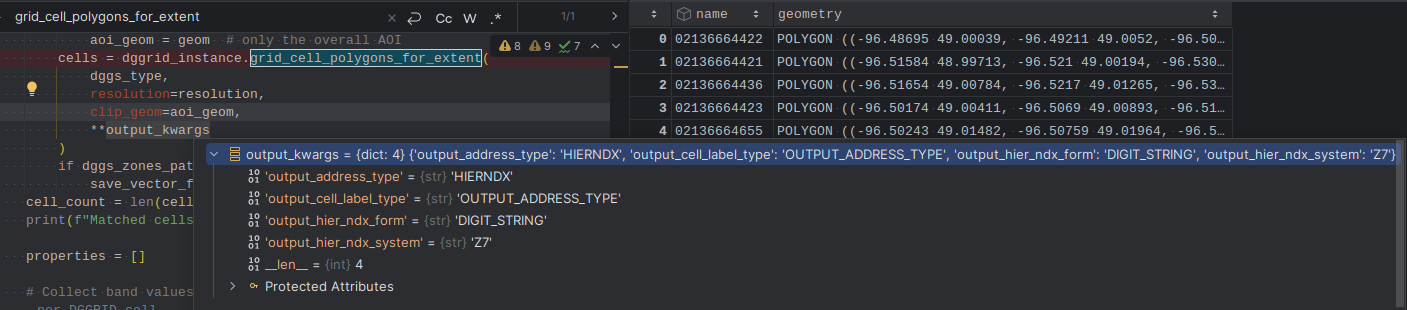
- class dggrid4py.DGGRIDv8(executable='dggrid', working_dir=None, capture_logs=True, silent=False, tmp_geo_out_legacy=False, has_gdal=True, debug=False)
- __init__(executable='dggrid', working_dir=None, capture_logs=True, silent=False, tmp_geo_out_legacy=False, has_gdal=True, debug=False)
Methods
__init__([executable, working_dir, ...])is_runnable()check_gdal_support()post_process_split_dateline(gdf)run(dggs_meta_ops)grid_cell_polygons_for_extent(dggs_type, ...)generates a DGGS grid and returns all the cells as GeoDataFrame with geometry type Polygon
grid_cell_centroids_for_extent(dggs_type, ...)generates a DGGS grid and returns all the cell's centroid as GeoDataFrame with geometry type Point
grid_cell_polygons_from_cellids(...[, ...])generates a DGGS grid and returns all the cells as GeoDataFrame with geometry type Polygon
grid_cell_centroids_from_cellids(...[, ...])generates a DGGS grid and returns all the cell's centroid as GeoDataFrame with geometry type Point
grid_cellids_for_extent(dggs_type, resolution)generates a DGGS grid and returns all the cellids as a pandas dataframe
cells_for_geo_points(geodf_points_wgs84, ...)takes a GeoDataFrame with point geometry and optional additional value columns and returns:
grid_stats_table(dggs_type, resolution[, ...])generates the area and cell statistics for the given DGGS from resolution 0 to the given resolution of the DGGS
dgapi_grid_gen(dggs, subset_conf, output_conf)Grid Generation.
dgapi_grid_stats(dggs)Output Grid Statistics.
dgapi_grid_transform(dggs, subset_conf, ...)Address Conversion.
dgapi_point_value_binning(dggs, subset_conf, ...)Point Value Binning.
dgapi_pres_binning(dggs, subset_conf, ...)Presence/Absence Binning.
cells_for_geo_points(geodf_points_wgs84, ...)takes a GeoDataFrame with point geometry and optional additional value columns and returns:
address_transform(cell_id_list, dggs_type, ...)generates the DGGS for the input cell_ids and returns all the transformed cell_ids cell_id_list is a list/numpy array, takes this list as seqnums ids (potentially also Z3, Z7, or ZORDER)